

Myopia (or near-sightedness) in children is a highly prevalent vision condition. It is estimated that the worldwide prevalence will reach about 50% by the year 2050 with about 9.8% people affected by high myopia. If untreated, children with high myopia run increased risks of serious eye disorders like retinal detachment, myopic maculopathy, glaucoma, cataracts, etc later in life. Traditionally used single-vision spectacle lenses (SVL) correct myopia but do not slow its progression. The efforts towards spectacle-based myopia control took concrete shape when, in 2021, two novel lens designs viz. Spectacle Lenses with Highly Aspherical Lenslets (HAL) and Spectacle Lenses with Slightly Aspherical Lenslets (SAL), each with peripheral lenslets showed no effect on tested visual functions and were found to be safe for myopia control. Subsequent studies showed that while both HAL and SAL reduced the rate of myopia progression and axial elongation, HAL has better myopia control efficacy. Also, long-term use of HAL spectacles reduced the incidence of high myopia and could impact retinal steepness and symmetry. Based on evaluation of evidence, US FDA granted marketing authorisation on 25 September 2025 to Essilor Stellest eyeglass lenses for children 6 to 12 years old. The device comprises of “spectacle lenses with aspherical lenslets”. Lenses have a clear 9 mm diameter area in the centre, which is surrounded by rings of peripheral lenslets (tiny, raised dots) on the rest of the lens. The peripheral lenslets provide peripheral light defocus, which help to slow the progression of myopia. Essilor Stellest eyeglass lenses are the first eyeglass lenses shown to slow progression of myopia in children.
Essilor Stellest eyeglass lenses, designed to correct and control progression of myopia in children 6 to 12 years old has received marketing authorisation by US FDA on 25 September 2025. The authorisation is based on evaluation of two-years of data from a clinical trial that showed Essilor Stellest eyeglass lenses slowed myopia progression as compared to single vision control lenses. It was granted Breakthrough Device designation earlier on 30 April 2021 to expedite its development and review.
The Essilor Stellest eyeglass lenses are spectacle lenses with “aspherical lenslets”. Lenses have a clear 9 mm diameter area in the centre, which is surrounded by rings of peripheral lenslets (tiny, raised dots) on the rest of the lens.
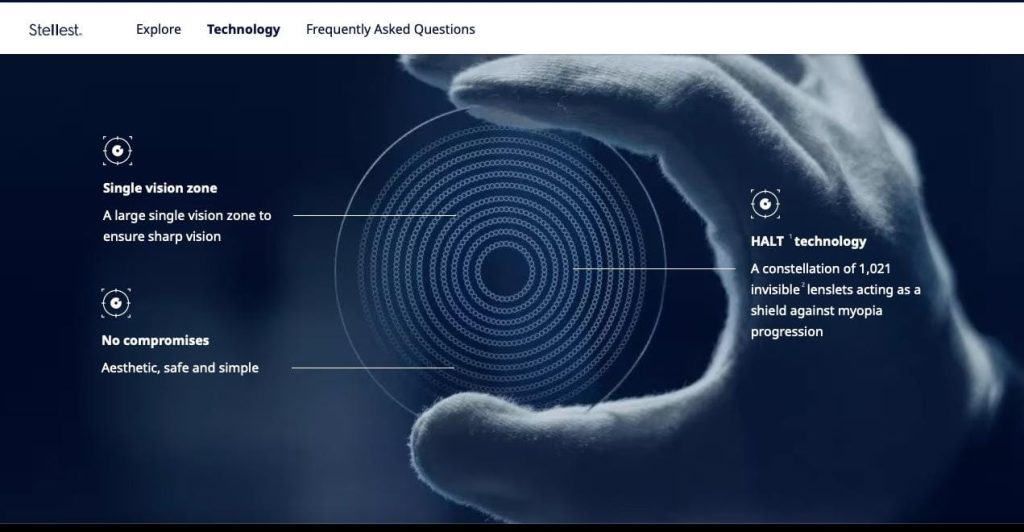
The peripheral lenslets provide peripheral light defocus, which may help to slow the progression of myopia in children. This is how Essilor Stellest spectacle lens is a novel improvement over to the regular concave lenses used to correct myopia.
Myopia in children – a significant global public health concern
Myopia (also known as near-sightedness or short-sightedness) is a common vision condition where close objects can be seen clearly, but distant objects appear blurry. The natural lenses and other parts of the eyes are affected in such a way that image of the objects focusses in front of the retina instead of on the retina. It is a highly prevalent vision condition, particularly among young people aged 10–25 years, that has assumed the scale of a significant global public health concern. Some Asian countries are worst affected. In China, about 47% of the total population suffered myopia in 2020. Prevalence in children and adolescents was 53.6% and the overall prevalence of in college students exceeded 90%. Similar trend is seen in East and South Asian countries. In the USA, it affects about 40% of the population where the prevalence rate among children and adolescents is rapidly increasing. Among white European overall prevalence is about 4.7% with 13.4% in Norway, 11.4% in Germany, and 19.9% in Ireland. Prevalence is lowest in Africa. In view of the current trend, it is estimated that the worldwide prevalence will reach about 50% by the year 2050 with about 9.8% people affected by high myopia. If untreated, people with high myopia run increased risks of vision complications (retinal detachment, myopic maculopathy, glaucoma, and cataracts) later in life. In view of the concerning disease frequency scenario, a comprehensive model for prevention and control of myopia in children and adolescents was considered an imperative. Spectacle-based myopia control is the key approach.
Novel design of spectacle lenses for myopia control
The efforts towards spectacle-based myopia control started taking concrete shape with the publication (in 2021) of results of evaluation of two novel lens designs for their effects on visual functions on visually normal adults. Each design had peripheral lenslets. A single vision lens (SVL) was used as a control. The two designs viz. Spectacle Lenses with Highly Aspherical Lenslets (HAL) and Spectacle Lenses with Slightly Aspherical Lenslets (SAL) were found to be safe for myopia control as they showed no effect on tested visual functions.
Following year in 2022, results of a clinical trial conducted on 157 children to assess efficacy of spectacle lenses with highly aspherical lenslets (HAL) and slightly aspherical lenslets (SAL) vis-a-vis traditional single-vision spectacle lenses (SVL) in controlling myopia progression spanning 2 years were published. The study showed that while both HAL and SAL reduced the rate of myopia progression and axial elongation, a higher asphericity of lenslets controls myopia more effectively, i.e., HAL is associated with better myopia control efficacy. This brought HAL design in spotlight.
Spectacle Lenses with Highly Aspherical Lenslets (HAL) prevents myopia
A further 5-year follow-up study (published on 5 March 2025) on 43 participants from the original HAL group revealed that use of spectacle lenses with highly aspherical lenslets (HAL) prevented the equivalent of 3 years of myopia progression and axial length (AL) elongation effectively. Also, long-term use of HAL spectacles reduced the incidence of high myopia. Another recent study (published on 29 March 2025) investigated effects of HAL on peripheral eye length (PEL) and peripheral refraction (PR) in children found that switching to or continuing to wear HAL could slow central and temporal elongation of eye length. Wearing spectacle lenses with highly aspherical lenslets (HAL) could impact retinal steepness and symmetry.
“Spectacle Lenses with Aspherical Lenslets” receives FDA’s marketing authorisation
Based on evaluation of two-years of data from the trial that showed Essilor Stellest eyeglass lenses slowed myopia progression (as compared to single vision control lenses), US FDA granted marketing authorisation on 25 September 2025 to Essilor Stellest eyeglass lenses which are designed to correct and control progression of myopia in children 6 to 12 years old. It is the first eyeglass lenses shown to slow progression of myopia in children. It was granted “breakthrough device” designation earlier on 30 April 2021 to expedite its development and review.
Until now, contact lens was the only approved device for controlling myopia progression for children in the 8-12 years age-group. The newly approved Essilor Stellest eyeglass lenses offer an option for children in 6–7 years age group. It also offers a low-risk option to all children who find it difficult to wear contact lenses due to adverse events like infections.
***
References:
- Zhao, L., et al. Prevalence and risk factors of myopia among children and adolescents in Hangzhou. Sci Rep 14, 24615 (2024). DOI: https://doi.org/10.1038/s41598-024-73388-7
- Gao Y., et al 2021. The impact of spectacle lenses for myopia control on visual functions. Published: 16 September 2021. DOI: https://doi.org/10.1111/opo.12878
- Bao J., et al.2022. Spectacle Lenses With Aspherical Lenslets for Myopia Control vs Single-Vision Spectacle Lenses: A Randomized Clinical Trial. JAMA Ophthalmol Published: 31 March 2022;140;(5):472-478. DOI: https://doi.org/10.1001/jamaophthalmol.2022.0401
- Li, X., et al 2025. Myopia control efficacy of spectacle lenses with highly aspherical lenslets: results of a 5-year follow-up study. Eye and Vis 12, 10 (2025). Published: 05 March 2025. DOI: https://doi.org/10.1186/s40662-025-00427-3
- Huang Y., et al 2025. Effect of spectacle lenses with highly aspherical lenslets on changes in peripheral eye length and asymmetry. Published: 29 March 2025. DOI: https://doi.org/10.1111/opo.13500
- Clinical trial – Stellest Lens Wear in Adult Progressing Myopes (SWAP). Available at https://clinicaltrials.gov/study/NCT06520124
- FDA News Release. FDA Authorizes Marketing of First Eyeglass Lenses to Slow Progression of Pediatric Myopia. 25 September 2025. Available at https://www.fda.gov/news-events/press-announcements/fda-authorizes-marketing-first-eyeglass-lenses-slow-progression-pediatric-myopia
- Essilor. Correct your vision – Stellest. Available at https://www.essilor.com/uk-en/products/stellest/
***
***
Related article
***

 in children is a highly prevalent vision condition. It is estimated that the worldwide prevalence will reach about 50% by the year 2050 with about 9.8% people affected by high myopia. If untreated, children with high myopia run increased risks of serious eye disorders like retinal detachment, myopic maculopathy, glaucoma, cataracts, etc later in life. Traditionally used single-vision spectacle lenses (SVL) correct myopia but do not slow its progression. The efforts towards spectacle-based myopia control took concrete shape when, in 2021, two novel lens designs viz. Spectacle Lenses with Highly Aspherical Lenslets (HAL) and Spectacle Lenses with Slightly Aspherical Lenslets (SAL), each with peripheral lenslets showed no effect on tested visual functions and were found to be safe for myopia control. Subsequent studies showed that while both HAL and SAL reduced the rate of myopia progression and axial elongation, HAL has better myopia control efficacy. Also, long-term use of HAL spectacles reduced the incidence of high myopia and could impact retinal steepness and symmetry. Based on evaluation of evidence, US FDA granted marketing authorisation on 25 September 2025 to Essilor Stellest eyeglass lenses for children 6 to 12 years old. The device comprises of “spectacle lenses with aspherical lenslets”. Lenses have a clear 9 mm diameter area in the centre, which is surrounded by rings of peripheral lenslets (tiny, raised dots) on the rest of the lens. The peripheral lenslets provide peripheral light defocus, which help to slow the progression of myopia. Essilor Stellest eyeglass lenses are the first eyeglass lenses shown to slow progression of myopia in children.)