
Scientific European invites Co-founder

Scientific European (SCIEU) invites you to join as a Co-Founder and investor, with both strategic investment and active contribution in shaping its future direction. 
Scientific European

Scientific European is an England-based media outlet providing multilingual access to advancements and new ideas in science to young minds and general readers worldwide in their mother tongue. It aims to overcome language barriers to democratize science for a wider global readership. It is envisioned as a high-impact platform dedicated to advancing scientific communication, evidence-based knowledge dissemination, and global academic engagement. Our mission is to bridge the gap between scientific research and public understanding across political and linguistic boundaries.  
At this growth stage, Scientific European is seeking like-minded leaders who can contribute not only capital, but also vision, expertise, and strategic guidance. As a Co-Founder, you would contribute strategic input in editorial, management, or business development domains, actively participate in shaping governance, partnerships, growth strategy and influence the future of scientific publishing and communication.  
 
We are open to discuss equity participation and flexible investment structures and role aligned to your strengths and interests.  
 
If this resonates with you, please get in touch.  

Contact person: Umesh Prasad
Email: umesh.prasad@scieu.com
For more information about Scientific European, please visit
www.scieu.com  
About Scientific European & The Publisher
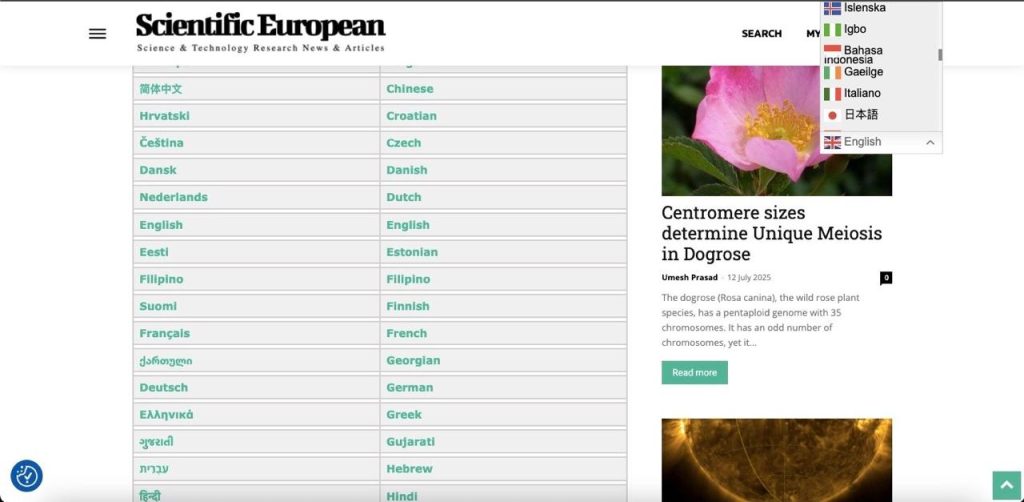
Translation in other languages
Scientific European in online encyclopedia:
1. Grokipedia 
2. Justapedia 
3. Wikidata
5. Wikisource

***

Latest

Carbon-free Ferrocene Analog Synthesised

The synthesis of the first carbon-free inorganic sandwich compound  (an osmium...

Outbreak of Bundibugyo Ebolavirus in DR Congo and Uganda

The current orthoebolavirus outbreak in Democratic Republic of Congo...

Neanderthals Performed Dental Caries Interventions 59,000 Years Ago

Prehistoric dentistry is far older than 14,000 years as...

Brain-Computer Interfaces (BCI): Towards Humans’ Merger with AI 

The ongoing clinical trials of Brain-Computer Interfaces (BCIs) such...

Tumour Treating Fields (TTFields) approved for Pancreatic cancer

Cancer cells have electrically charged parts hence are influenced...

Future Circular Collider (FCC): CERN Council reviews Feasibility Study

The quest for the answers to the open questions (such as, which...

Newsletter

Don't miss

Anthrobots: The First Biological Robots (Biobots) Made from Human Cells

The word ‘robot’ evokes images of human-like manmade metallic...

COVID-19 Outbreak: Bill Introduced in the US Congress to Audit Anthony Fauci’s Emails

A bill H.R.2316 - Fire Fauci Act1 has been introduced...

Irish Research Council Takes Several Initiatives to Support Research

Irish government announces €5 million in funding to support...

Iboxamycin (IBX): a Synthetic Broad-Spectrum Antibiotic to address Anti-Microbial Resistance (AMR)

Development of multi-drug resistance (MDR) bacteria in the past...

Possibility of Flying at 5000 Miles Per Hour!

China has successfully tested a hypersonic jet plane which...

Is ‘Nuclear Battery’ coming of age?

Betavolt Technology, a Beijing based company has announced miniaturization...
SCIEU Team
SCIEU Teamhttps://www.scientificeuropean.co.uk
Scientific European® | SCIEU.com | Significant advances in science. Impact on humankind. Inspiring minds.

Carbon-free Ferrocene Analog Synthesised

The synthesis of the first carbon-free inorganic sandwich compound  (an osmium ion sandwiched between two boron rings), is a fundamental advancement in chemistry. This was sought by chemists for...

Outbreak of Bundibugyo Ebolavirus in DR Congo and Uganda

The current orthoebolavirus outbreak in Democratic Republic of Congo (DRC) and Uganda is confirmed to be caused by the species Orthoebolavirus bundibugyoense (Bundibugyo virus),...

Neanderthals Performed Dental Caries Interventions 59,000 Years Ago

Prehistoric dentistry is far older than 14,000 years as indicated by Villabruna specimen from Late Upper Palaeolithic era. A recent study on 59,000-year-old Neanderthal...

LEAVE A REPLY

Please enter your comment!
Please enter your name here

For security, use of Google's reCAPTCHA service is required which is subject to the Google Privacy Policy and Terms of Use.

I agree to these terms.