

Nancy Grace Roman Space Telescope (commonly referred to as Roman telescope) is set to be launched into space on 30 August 2026. It will be placed in and operate from a quasi-halo orbit around the second Sun-Earth Lagrange point (L2) in the neighbourhood of the James Webb Space Telescope (JWST) at a distance of 1.5 million km from the Earth.Dedicated to the study of dark matter, dark energy, and exoplanets, Roman Telescope will perform large surveys of more than a billion galaxies and galaxy clusters mapping the distribution and evolution of matter and measuring expansion history of universe. This will give an idea about the effects of dark matter and dark energy on shapes and distributions of galaxies and galaxy clusters in the universe. It will observe distant Type Ia supernovae, which act as tracers of the universe’s accelerated expansion to characterize dark energy. Using microlensing, direct imaging, and transits, Roman will also search and study exoplanets and is expected to reveal more than 100,000 exoplanets as they transit their host stars. Roman will capture larger images and will provide big-picture view, while James Webb Telescope makes powerful observations seeing farther back in time with higher resolution. Together they can be of great help in astronomical studies.
Celestial bodies (such as stars, planets and moons) and their periodical movements as seen in the night sky have always intrigued human minds since the prehistoric era. Night-sky observations of positions and pattern of movement of stars have historically been used for finding direction and navigation during voyages. Invention of telescope, the device to observe distant objects by their emission, absorption or reflection of electromagnetic radiation in the early 17th century was a milestone as it helped in overcoming limitations of naked eye observation and made detailed astronomical observations possible. Optical telescopes dominated the field in the beginning, however, soon radio telescopes and solar telescopes found applications in the fast-emerging field of astronomy. Soon, it was realised that astronomical observations made by the earth-based telescopes suffered distortions due to disturbances in Earth’s atmosphere. One possible solution was to place telescopes in the space because space-based telescopes offered advantages in terms of clear images, wider spectrum access and deeper space visibility vis-à-vis earth-based telescopes.
Space Telescopes
The idea of a space-based telescope was put forward by Lyman Spitzer in 1946. It was thought that the observations made by the telescope located in the space would be free of distortions caused by the Earth’s turbulent atmosphere. Also, it would be possible for a space telescope to observe UV, X-ray, and infrared wavelengths which are absorbed by the air molecules in the atmosphere. Orbiting Astronomical Observatory 2 (OAO-2), popularly known as Stargazer, was the first successful space telescope that made observations in UV range. It was launched in 1968 and remained operational till 1973.
Hubble Space Telescope is perhaps the most commonly known space telescope. It is a large optical observatory and was launched in 1990. Parked 400 km above the Earth in a low Earth orbit, Hubble telescope has been operational for the past 35 years. Its deep-field observations have revealed thousands of previously unknown distant galaxies. It has also contributed in the calculation of the accurate age and expansion rate of the universe and is considered a major milestone in space-based astronomical observation.
The James Webb Space Telescope (JWST) is another significant name. Launched on 25 December 2021, JWST is the largest and most powerful space telescope so far. Unlike Hubble which is an optical observatory in the low Earth orbit, JWST is an infrared observatory located at the second Lagrange point (L2), about 1.5 million km away from Earth.Dedicated to the study of the early universe, JWST is designed to look back over 13.5 billion years to observe the first galaxies formed after the Big Bang. In the last five years of operation, JWST has revolutionised the field of astronomy, particularly the study of early universe.
Nancy Grace Roman Space Telescope
Set to be launched on 30 August 2026, Nancy Grace Roman Space Telescope, or simply Roman Telescope is named after Nancy Grace Roman who was NASA’s first chief astronomer credited with having spearheaded the Hubble Space Telescope project. Unlike Hubble which is placed in the low Earth orbit, Roman will be placed in and operate from a quasi-halo orbit around the second Sun-Earth Lagrange point (L2) in the neighbourhood of JWST at a distance of 1.5 million km from the Earth.
Roman Telescope will be over 12.7 meters long and more than 4.4 meters wide when fully deployed. Its resolution and sensitivity will be comparable to Hubble’s by virtue of its same sized (i.e., 2.4 meters in diameter) primary mirror.
However, Roman will have a field of view 100 times larger courtesy of its 300-megapixel multi-band near-infrared camera called Wide Field Instrument (WFI), which will provide wide field imaging and spectroscopy. A wide field of view with high resolution imaging and fast survey speeds will enable Roman Telescope to perform large surveys of more than a billion galaxies and galaxy clusters mapping the distribution and evolution of matter and measuring expansion history of universe. This will give an idea about the effects of dark matter and dark energy on shapes and distributions of galaxies and galaxy clusters in the universe.
Roman Telescope will also observe distant Type Ia supernovae, which act as tracers of the universe’s accelerated expansion to characterize dark energy. Clearly, Wide Field Instrument (WFI) will play the key role in the study of dark matter and dark energy by the Roman Telescope. Because of seminal role of Wide Field Instrument, Roman was formerly called the Wide Field Infrared Survey Telescope (WFIRST).
Roman will search for and study exoplanets as well. It will use microlensing, direct imaging, and transits for this. Roman’s observations are expected to reveal more than 100,000 exoplanets as they transit their host stars. The Coronagraph Instrument on board the Roman Telescope will block the intense star glare and photograph exoplanets and debris disks in orbit around them.
Roman will thus contribute to the study of the dark matter, dark energy, and exoplanets.
Roman Telescope and James Webb Telescope
Both Nancy Roman and James Webb space telescopes will operate at the same time. Both will primarily study the universe in infrared light, however, they differ in their imaging capabilities but can complement each other in the study of astronomical phenomena.
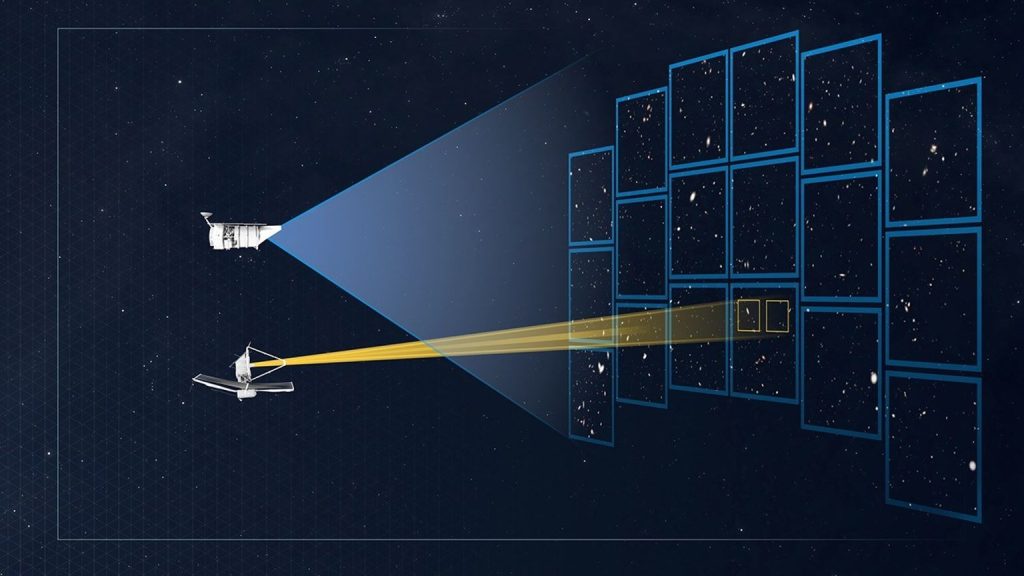
While Wide Field Instrument (WFI) enables Roman to capture larger images (50 times larger than Webb can) and provide big-picture view, James Webb Telescope makes powerful observations seeing farther back in time with higher resolution. This is because Webb’s primary mirror is much larger (6.5 meters) compared to Roman’s (2.4 meters).
Roman’s big-picture view and Webb’s powerful observations together can be of great help in astronomical studies.
Roman Telescope will have a primary mission lifetime of five years, and a five-year extended mission.
***
References:
- NASA. Nancy Grace Roman Space Telescope. Available at https://science.nasa.gov/mission/roman-space-telescope/
- NASA’s Roman Space Telescope Begins Integrated Operations for Launch. Posted 10 August 2026. Available at https://science.nasa.gov/blogs/roman/2026/08/10/nasas-roman-telescope-team-begins-integrated-operations-for-launch/
- NASA’s Curious Universe – Roman series: NASA’s New View of the Dark Universe. Season 13 Episode 1. Posted 11 August 2026. Available at https://www.nasa.gov/podcasts/curious-universe/roman-series-nasas-new-view-of-the-dark-universe/
- NASA’s Curious Universe – Roman series: Jupiters around other suns. Season 13 Episode 2. Posted 18 August 2026. Available at https://www.nasa.gov/podcasts/curious-universe/roman-exoplanets/
- Bartusek, L. M. L., et al. “Nancy Grace Roman Space Telescope Observatory Implementation and Challenges,” 2022 IEEE Aerospace Conference (AERO), Big Sky, MT, USA, 2022, pp. 01-14, DOI: https://doi.org/10.1109/AERO53065.2022.9843415
***
Related articles:
- Brown Dwarfs (BDs): James Webb Telescope Identifies Smallest Object formed in a Star-like manner (5 January 2024)
- James Webb Space Telescope (JWST): The First Space Observatory Dedicated to the Study of Early Universe (6 November 2021)
- JWST’s Deep Field Observations Contravene Cosmological Principle (28 March 2025)
- James Webb (JWST) redefines appearance of Sombrero galaxy (Messier 104) (26 November 2024)
- Paradox of Metal-rich Stars in Early Universe (27 September 2024)
- Early Universe: The Most Distant Galaxy “JADES-GS-z14-0″ Challenges Galaxy Formation Models (12 August 2024)
- XPoSat : ISRO launches World’s Second ‘X-ray Polarimetry Space Observatory’ (1 January 2024)
- James Webb’s Ultra Deep Field Observations: Two Research Teams to Study Earliest Galaxies (24 June 2022)
- Discovery of the first Exoplanet Candidate outside our Home Galaxy Milky Way (28 October 2021)
- Exoplanet Study: Planets of TRAPPIST-1 are Similar in Densities (25 January 2021)
***

 is set to be launched into space on 30 August 2026. It will be placed in and operate from a quasi-halo orbit around the second Sun-Earth Lagrange point (L2) in the neighbourhood of James Webb Space Telescope (JWST) at a distance of 1.5 million km from the Earth. Dedicated to the study of dark matter, dark energy and exoplanets, Roman Telescope will perform large surveys of more than a billion galaxies and galaxy clusters mapping the distribution and evolution of matter and measuring expansion history of universe.)